

As a business coach, I work with my clients on exploring risk vs. reward with every decision. As much as I believe that a woman entrepreneur must be fearless in order to build a business: fearless does not mean unintelligent. There will always be risks in business, but a successful entrepreneur knows how to measure the risk vs. the reward. 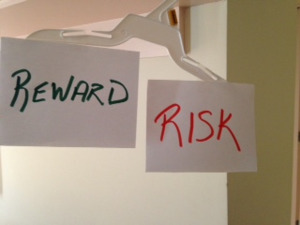 The most important part of the puzzle is that the reward must take you closer to your goal. If you don't have goals for your business than measuring risk vs. reward is just an exercise in futility. Let me explain why.
Most business risks require some type of financial investment. The entrepreneur may need to go into debt, leverage a successful business or tap an outside investor for money by giving up equity in the new venture. At first look, the entrepreneur will want to know that this financial risk will be rewarded with greater financial assets. These assets will be necessary to pay off the debt or leverage that was incurred to attain it. If the risk that was taken was to bring on an equity partner, then the entrepreneur have better been prepared for this partnership should (s)he want to divest the business in the near future. A partner in a successful new venture who came in with cash and no time required is likely not to be as ready to exit. In other words, what was the intended goal when the risk of increased financial investment was determined as a next step in the developing business?
You would be surprised as to how often I meet entrepreneurs with risky ideas about next steps for their business, but haven't thought through the goal of the risk. They are proud to be in the fearless mode of taking risks and are not too concerned with the rewards as they have convinced themselves that they are ready for the challenge. When I burst their bubble by asking what the goal of the risk-taking is, I am looked at by surprise that I don't get the boldness of their idea.
For example, Sue (not her real name) has a small restaurant. She has spent the last ten years building a strong customer base and the business is stable. Sue has gotten complacent and lost the excitement she once had for the business. She has decided to open a second restaurant. She had at one time owned two restaurants. As we sit down to discuss her bold idea, she explains all the reasons that she believes her plan is well worth the risk. When I ask her what her goal is for the entire business, she is surprised that I am not as excited about her fearlessness as she is and wonders if I don't have faith in her ability to operate two restaurants. So, I ask again, "Sue, what is your real goal for your business?"
Within a few minutes, Sue admits she hasn't given any thought beyond starting up a new location. Her real goal for her business is to sell it someday, most likely within the next 5 years, and do something that requires less of her time. "Exactly!" I say. "Starting a new venture is not only risky, but the reward may not materialize until very close to the time you want to exit. Of course, there are buyers who will buy two restaurants as long as they are both profitable, but you are clearly limiting your options." Operating costs for two may just double your income thereby not generating any more profit. Therefore, the risk vs. reward may be equal, but your goal will suffer.
The bottom line for every woman entrepreneur is to carefully balance the potential risk you want to take with the hopeful reward while making sure that the planned outcome will bring you closer to your goal. Business is not a race, but a marathon. Even though you are willing to take the risk to get the reward you must prepare of the journey.
