

The media provides a daily dose of articles of why women entrepreneurs don't grow their businesses as large as male entrepreneurs. The reasons range from lack of capital to lack of connections to lack of role models to lack of willingness to take risk. The fact is many women entrepreneurs choose to keep their businesses small. Not wanting to grow a business beyond a $1 million in revenue is not a crime....it is often a choice.
What women entrepreneurs and all small business owners need to pay strict attention to is profit margins. Growing your piece of the pie is critical to your success in business. 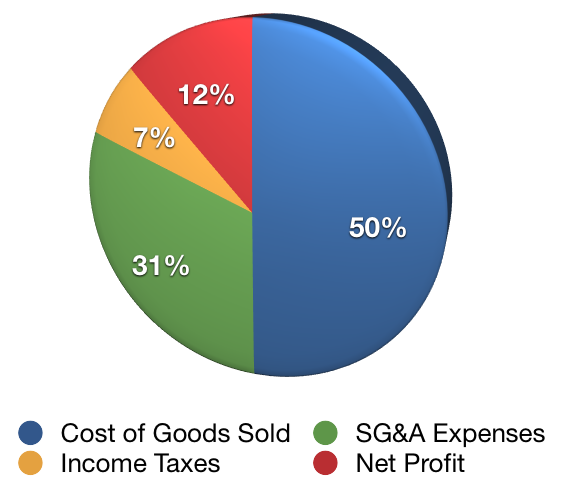
A break- down of most busi- nesses might look something like the picture here. The costs of goods sold is the lion's share of the expenses. Next in line is the company's expenses. Expenses include rent, utilities, telecommunications, payroll, office supplies, equipment and anything else required to operate the business. Of course, every business is required to pay taxes. Depending on the type of business you operate and the success of your business this % will flucturate. But, taxes are not something you the business owner have a lot of control over. In other words, as you work to increase your net profit margin your focus will be on how you can reduce your expenses and keep your costs of goods sold under control.
The example here suggests a net profit of 12% which is a pretty healthy margin. But there are savvy entrepreneurs who find ways to demonstrate 25% or more net profit margins. A small business with $1 million in revenues with 25% or more net profit margins shows $250,000 + at the end of the year (yes, this is after taxes). The women entrepreneurs, I know, operating businesses like this, aren't concerned with what the media has to say about their not growing the business to $10 million or more. They are comfortable where they are and spend time thinking and planning for the day they will exit the business. Depending on the type of business, the owner of this business just might exit with $1 million or more - just the number women report they want for retirement.
If you are a business owner and don't know your net profit margin it's not too late! Sit down with your accountant, bookkeeper or with your quick books and learn exactly where your money is going. You can't work to increase your profit margin until you know where you are spending. Once you learn what's happening in your business you'll be more likely able to control your expenses. You won't mistakenly give raises without figuring out how to pay for them. When your rent increases you'll create a plan for how to plan for it so it doesn't effect your bottom line.
Finally, service businesses are different from the example above as they do not have cost of goods sold. However, pricing the service and building in a cushion for the sales cycle is critical for staying on top of your profit margin.
Now go out and grow your small business to whatever size feels right to you. Size doesn't matter. Just make sure you keep your eye on your profit margin.
