

Mentorship is something that is talked about more and more today for students as well as business people. Yet, when I ask my clients about mentors they have had in the past or currently, the majority tell me they have never had a mentor. Since most of my clients are women, I decided to reach out to the men in business I know and ask the same question: Have you ever had or do you currently have a mentor? The answer I heard most often was YES! So, why is it that the men I spoke with have mentors and the women don't?
The answer, I discovered, is most women don't completely understand the process or the purpose of mentoring. 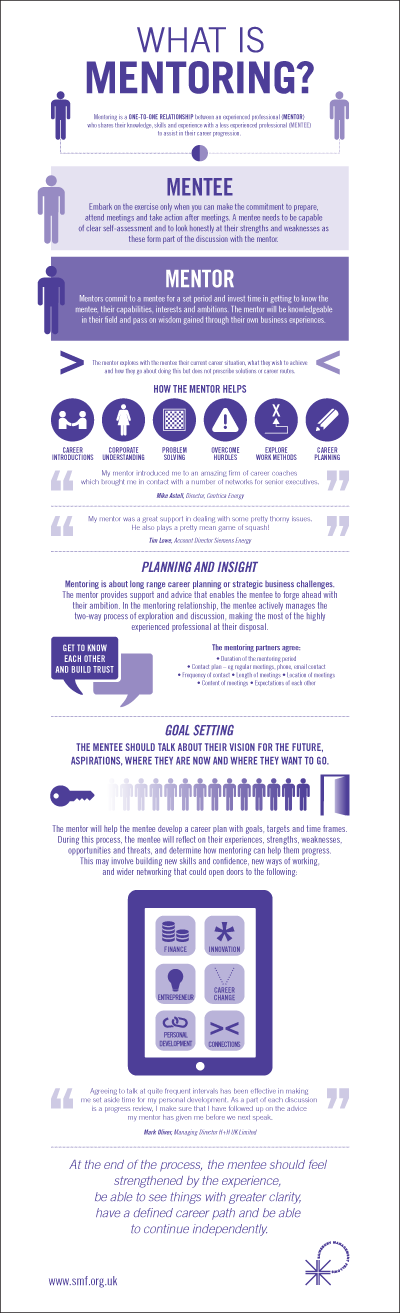
First, Merriam-Webster dictionary defines mentor as a 'trusted counselor or guide, a coach or tutor". Simply put, it is the one-to-one relationship between a mentor and a mentee. The question then becomes how does one know if she is fit to be a mentee or a mentor or either?
A mentee must be:
* willing to put the necessary time in to building a relationship with a mentor.
* willing to listen and respect advice based on the mentor's experience and then filter it for her own particular scenario.
* willing to be open and honest about the choices she makes.
* willing to open herself up to trusting her mentor and the mentoring relationship.
* willing to look at all angles of every situation.
* willing to take risk for personal growth.
A mentor must be:
* willing to put in the necessary time in getting to know the mentee.
* willing to be a good listener.
* willing to ask probing questions without being judgmental.
* willing to be a cheerleader for the mentee.
* willing to explore opportunities rather than solutions.
* willing to see the mutually beneficial opportunity for personal growth from the relationship.
Both mentee and mentor must realize the importance of flexibility in the mentoring relationship. Mentors DO NOT have all the right answers or even all the right questions. Mentees ARE responsible for their own decisions and must take ownership of the choices they make.
So, let's get back to the question of why more men than women seem to take advantage of and work with mentors. Men told me that they had either been assigned a mentor at work (almost always male) or ask a male colleague they admired.. The relationship tended to be free flowing from the start. The rules, although rarely stated, seemed to be understood by both parties. In other words, the mentoring process was natural.
Women in business told me they didn't know how to ask either a male or female colleague to be their mentor. The general comment was, "I feel as though I am admitting my weaknesses to another person at work." Rather than look at the mentoring opportunity as an opportunity to advance, too many women look at it as an admittance of lack of experience. The few women who shared their mentoring experience with me confessed to getting started because thier workplace demanded it of them.
So, how can women in business reach out to find a mentor and get started?
(1) Know yourself well enough to decide whether a male or female mentor will work best for you. There are no gender rules in mentoring. The best mentor for you is the person, male or female, that you can talk with comfortably on a regular basis and be willing to be critique by and championed by.
(2) Look for him or her at work, at professional events, networking events and industry conferences. Start a conversation and start building a relationship. Find out everything you can about your potential mentor's work experience and other things you might have in common. The common denominators will be the foundation of getting to know each other.
(3) Once you have built the relationship ask her/him if a mentoring relationship would also be possible. True mentors will become friends for life and that is exactly what you want.
There are few relationships in life that can be as powerful and as satisfying as the mentoring relationship. It can transform both individuals in ways that have direct impact on career and personal development.
Women in business, in some respects, are still in their infancy in the workplace as well as as entrepreneurs. Women need to believe that it is okay to crawl before we walk and walk before we run and with a mentor that process is supportive and empowering.
Take action on finding a mentor today and tomorrow share your experience with your mentee. There is no better way to pay it forward than by mentoring a member of the next generation of women in business.
